
Air ventilation in Enclosed Spaces
Air ventilation in enclosed spaces plays a key role in indoor air quality, occupant health, and energy efficiency of buildings. Poor air ventilation or circulation can lead to issues such as pollutant build-up, increased humidity, and the spread of microorganisms, all of which affect comfort and safety.
What is the main danger of enclosed spaces?
The main issue with enclosed spaces is the lack of air renewal—stagnant air or poor air ventilation. Air renewal ensures the highest possible intake of outdoor air, either through natural ventilation or HVAC systems.
What should we avoid in enclosed spaces?
According to the WHO (World Health Organization), based on the SARS-CoV-2 transmission report (conducted during COVID-19) and the study “Small droplet aerosols in poorly ventilated spaces and SARS-CoV-2 transmission”, we must avoid stagnant air in enclosed areas. The study simulates airborne droplets produced by coughing and compares different types of ventilation in enclosed spaces. In the best-ventilated room, after 30 seconds, the number of airborne droplets had halved, while without air ventilation, this took around 5 minutes.
Additionally, research from the National Institute of Allergy and Infectious Diseases (Hamilton, MT) found that particles can remain suspended in the air for up to three hours without airflow, and people can get infected by inhaling them.
As seen in simulations, aerosols can travel several meters and reach heights of up to three meters:
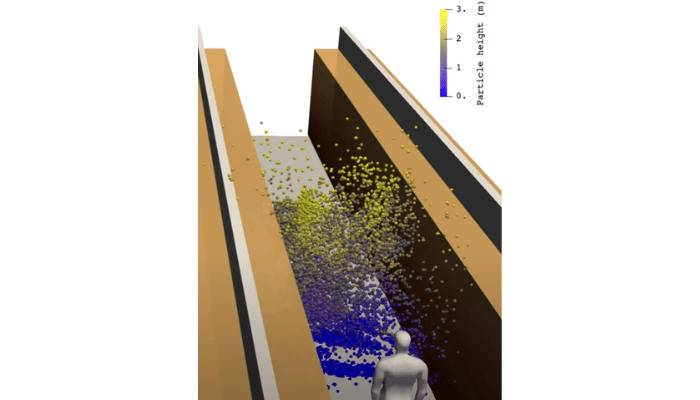
Considering that aerosols are released even when an asymptomatic person exhales, talks, or sings, it’s very easy for infections to occur indoors due to stagnant air.
Why is air ventilation important in enclosed spaces?
Poorly ventilated enclosed spaces can lead to problems such as:
- Build-up of CO2 and pollutants: can cause fatigue, headaches, and reduced concentration.
- Increased humidity and condensation: encourages mold and bacteria growth, damaging the building structure.
- Poor air quality: may trigger allergies, respiratory irritation, and other health issues.
Stuffy and uncomfortable environments: lack of air circulation decreases freshness and thermal comfort.
What are the options for ventilating enclosed spaces?
There are several air renewal methods suitable for small or large spaces:
Natural air ventilation
The simplest and most economical method for improving ventilation in enclosed spaces, involving the opening of windows and doors. It works best in areas with cross-ventilation, allowing efficient air exchange.
Mechanical ventilation
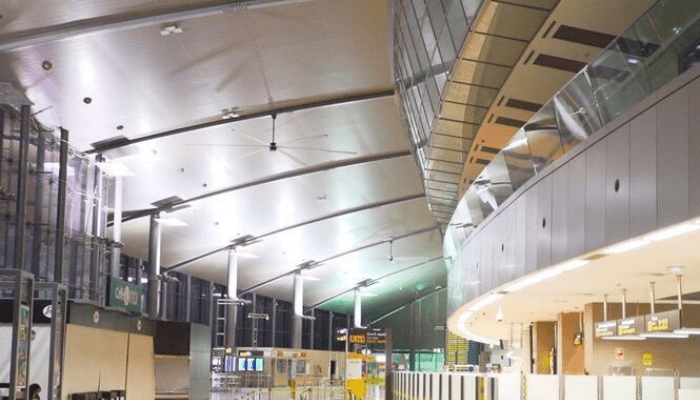
In large buildings like shopping centers, offices, airports, etc., mechanical air ventilation is the ideal solution to ensure consistent air renewal.
- The Airwall wall-mounted exhaust fan helps extract and renew air in buildings, especially gyms, farms, and industrial facilities.
- Ceiling fans improve air distribution, preventing stagnant air. They also boost the efficiency of HVAC systems and reduce the need for additional heating or air conditioning.
- Using directional industrial fans helps enhance ventilation in specific areas by directing the airflow toward targeted points.
- In facilities with smoke vents, HVLS industrial fans can operate in reverse mode to act as extractors. This allows them to pull stagnant air from floor level and push it up toward ceiling-level vents for expulsion. When fewer people are present, the fans can be reversed to draw fresh air inside the building.
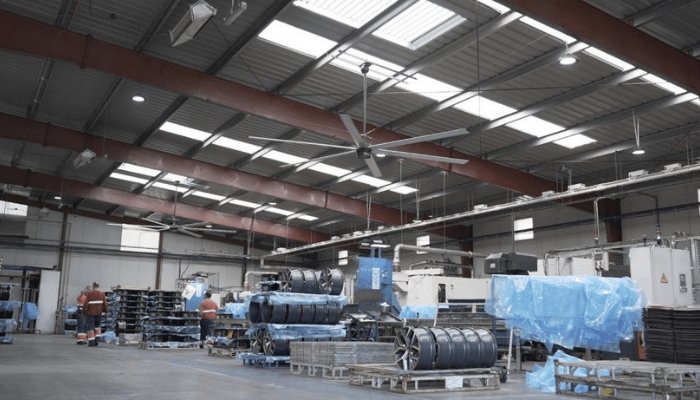
Enclosed buildings such as airports, stations, or malls typically have air renewal systems that should operate at full capacity to maximize airflow. These systems inject fresh air at lower levels and extract stale air from upper layers. HVLS ceiling fans help avoid stagnant air at floor level by pushing lower air upwards, enhancing the performance of air ventilation systems and making the air people breathe healthier.

This simulation shows how floor-level air (where people are) is cleaned, travels up the wall, and is captured by air renewal systems at lower speed:
What is the recommended number of air changes per hour?
According to Spain’s Ministry of Health guidelines, a minimum of 12.5 L/second per occupant (450m³/h) is recommended, even in commercial settings. This is the air quality level defined as IDA 2: good quality air by the Building Thermal Installations Regulation.
To calculate how much air is being extracted, multiply the opening area by the air velocity.
For example, a 20m² room with a height of 2.6m, a 75x120cm window, and a fan moving air at 0.2–0.8 m/s would achieve between 12.5 and 50 air changes per hour, ensuring a full air renewal in under 5 minutes.
If air velocity is 0.8 m/s, up to five people can occupy the 20m² room safely.

HVLS fans designed by Magnovent ensure an airspeed of 0.5–1.2 m/s at floor level throughout the ventilated area, enabling very high air change rates, especially when there are more openings or stronger extraction flows.
In short, using ceiling fans, whether domestic or HVLS industrial, together with smoke vents, open windows and doors, or mechanical ventilation systems is a highly effective solution for ensuring high air change rates in enclosed spaces. This significantly helps prevent virus transmission due to poor ventilation, as recommended by health authorities and the WHO.
