
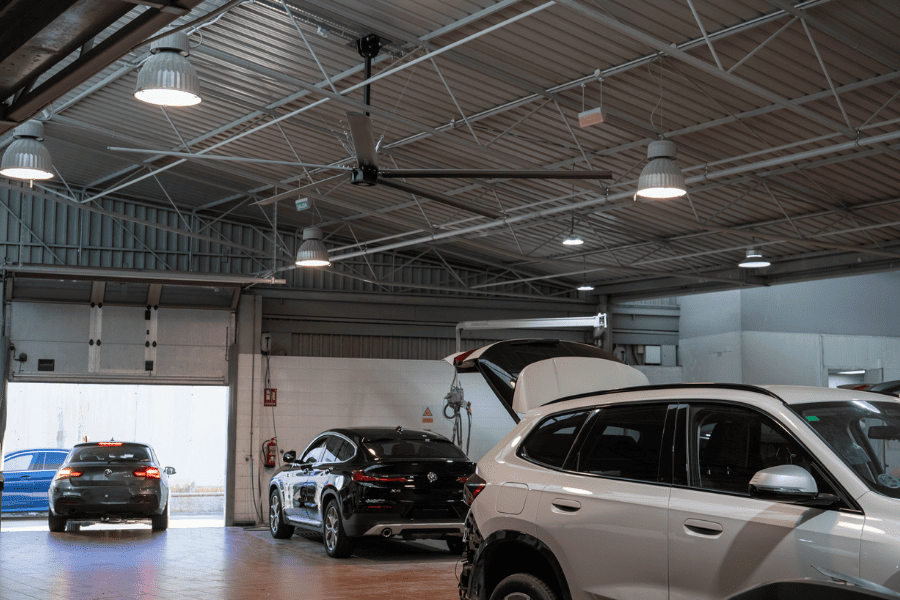
High summer temperatures, the constant movement of vehicles and the large dimensions of automotive facilities make maintaining a comfortable working environment in automotive workshops a real challenge. In these conditions, efficient ventilation solutions are essential to support employee well-being and improve thermal conditions without significantly increasing energy consumption.
To address this challenge, Benigar, an official BMW, MINI and BMW Motorrad dealership group operating in Alicante and southern Valencia, has partnered with Magnovent to improve industrial ventilation for automotive workshops through a bioclimatic solution based on industrial HVLS fans.
The project, carried out during the summer of 2026, involved installing 49 HVLS fans across 12 Benigar facilities, achieving an average reduction in perceived temperature of 5.1°C throughout the summer, with an average reduction of 5.9°C in August and occasional reductions approaching 8°C.
The challenge: improving industrial ventilation for automotive workshops and combating heat
To understand why ventilation in automotive workshops is so important, we need to consider the specific conditions of these facilities. Large floor areas, open doors to accommodate vehicle movement and roofs exposed to direct sunlight make conventional air conditioning less effective. In addition, daily workshop activities can contribute to heat accumulation and uncomfortable indoor temperatures.
For Benigar, the objective was to reduce heat stress among mechanics and aftersales professionals, improving their working conditions and the thermal comfort of the workshops without relying on conventional, energy-intensive air conditioning systems.
To achieve this, the company needed an industrial ventilation solution for automotive workshops capable of:
- Promoting air circulation across large areas.
- Adapting to the characteristics of each facility.
- Providing energy-efficient operation.
The project forms part of Benigar’s Environmental Comfort Plan, an initiative combining technical improvements, organisational measures and suitable equipment to protect employee well-being during periods of extreme heat.
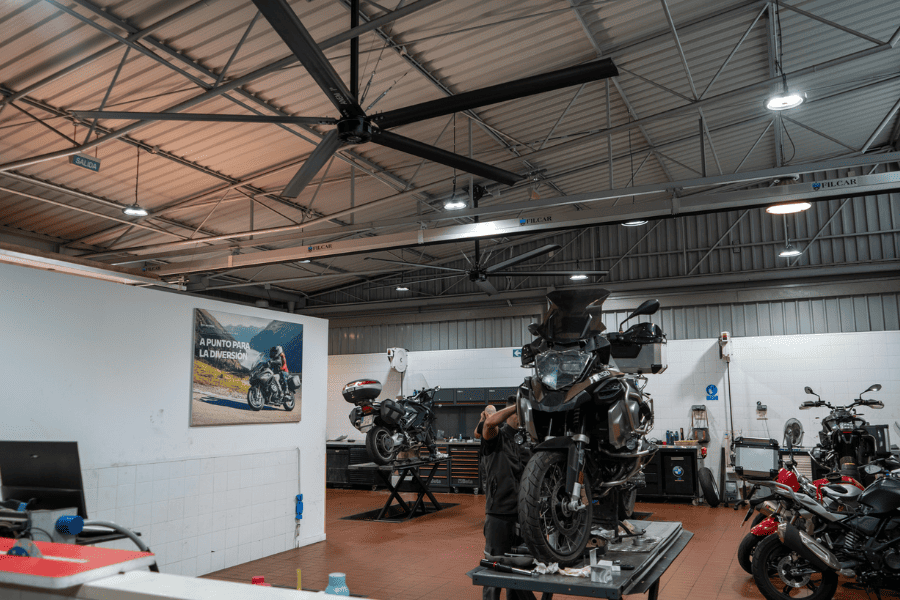
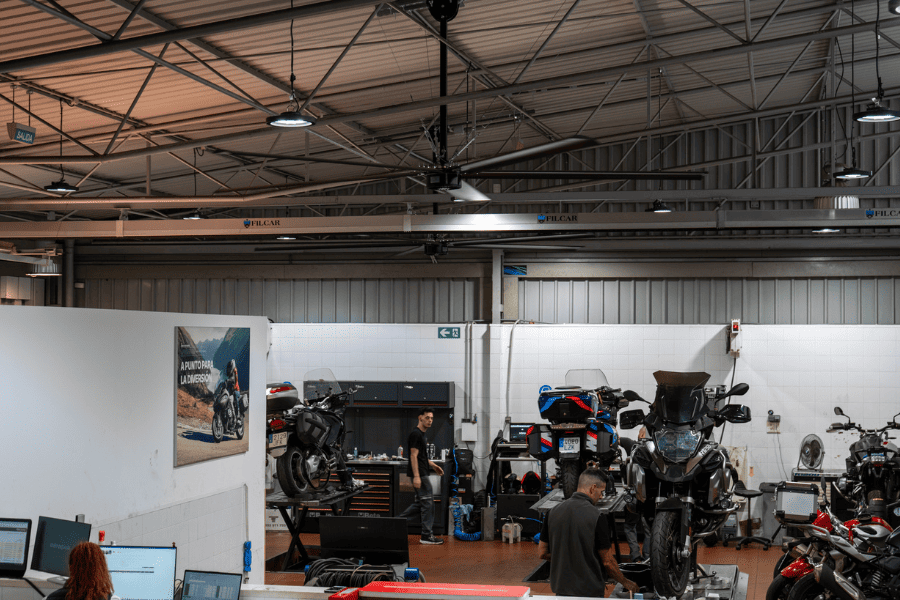
Magnovent’s solution: 49 HVLS fans across 12 facilities
When determining how to ventilate large automotive workshops, it is important to analyse factors such as building height, space layout and air circulation requirements.
To meet Benigar’s needs, Magnovent planned and implemented an industrial ventilation solution based on HVLS (High Volume, Low Speed) technology, developing an appropriate strategy to move large volumes of air throughout spacious facilities.
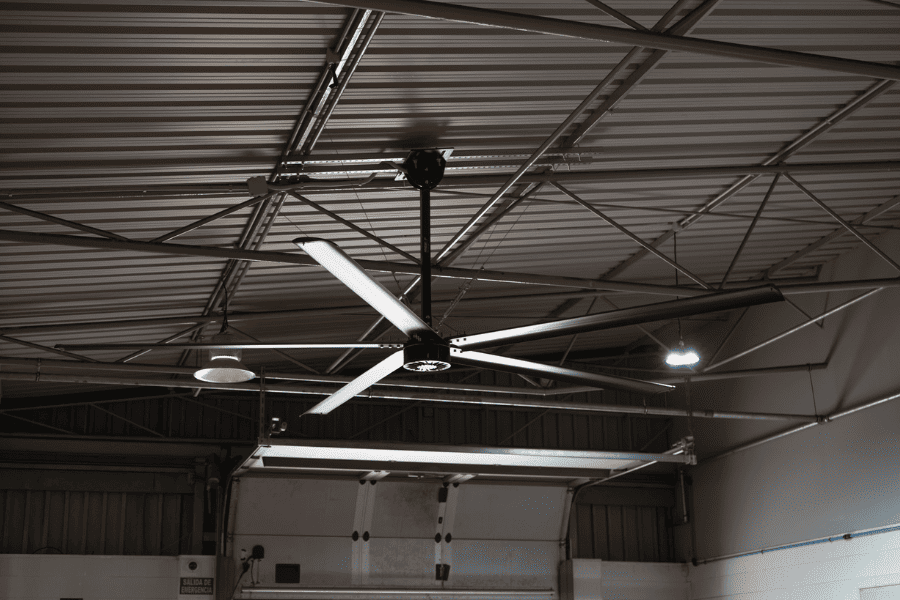
Industrial HVLS fans use large-diameter blades that rotate at low speeds to generate a wide-reaching airflow. This air movement promotes sweat evaporation and body heat dissipation, helping to reduce perceived temperatures without having to cool the entire volume of air inside the building.
The project included the installation of 49 industrial fans across 12 Benigar facilities located in Alicante and southern Valencia. Of these, 36 units are connected and monitored through MAGNOHUB.
Magnovent’s intelligent control system allows compatible equipment to be monitored centrally and its operation adjusted to the requirements of each facility, helping to improve ventilation management in large spaces.
Results: perceived temperatures reduced by almost 8°C
The initial results of the project were obtained from a pilot installation at Benigar’s facility in Elche, where the performance of the HVLS fans was evaluated throughout the summer.
According to data provided by Benigar, the average reduction in perceived temperature was 5.1°C during the summer, reaching an average of 5.9°C in August, with occasional reductions approaching 8°C over the summer months.
These results demonstrate how effective air circulation can help improve thermal comfort for employees and customers, particularly during periods of intense heat.
The Benigar case therefore highlights the potential of an industrial ventilation solution for automotive workshops designed to promote air movement and reduce the sensation of heat without having to cool the entire indoor air volume.
A project improving working conditions for 267 professionals
The project developed with Magnovent directly benefits 267 professionals working in Benigar’s aftersales departments, representing approximately 62% of the group’s workforce.
Improving thermal comfort forms part of Benigar’s commitment to adapting its facilities to extreme temperatures and creating more comfortable working environments.
In this context, industrial ventilation for automotive workshops not only addresses a technical requirement but can also form part of broader business strategies focused on improving employee well-being and providing more suitable environmental conditions throughout the working day.
Furthermore, this initiative contributes to the company’s sustainability strategy, which prioritises energy efficiency, energy consumption monitoring and the use of electricity from renewable sources.
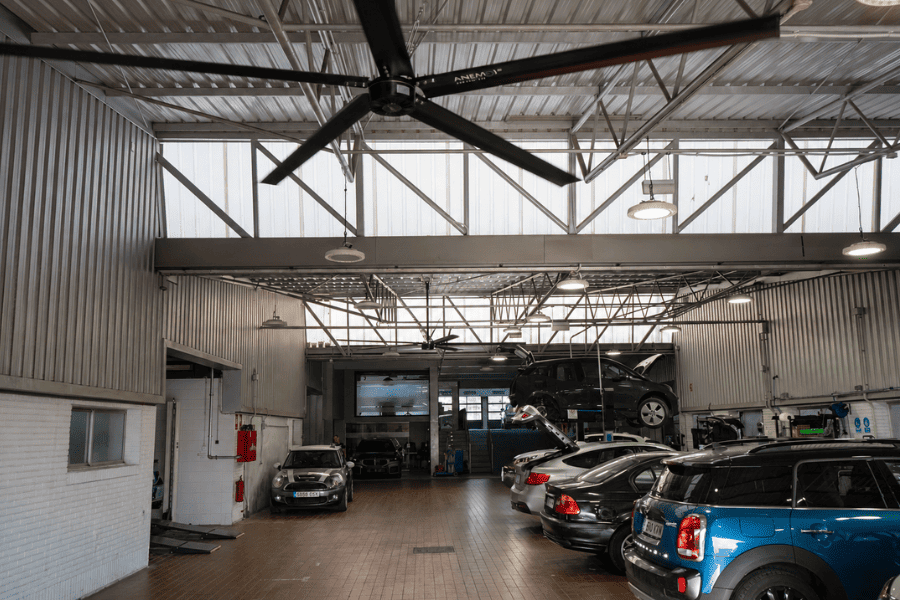
Beyond ventilation: new opportunities for energy efficiency
Following the installation of the HVLS fans, Benigar is exploring additional measures to further improve the thermal performance of its facilities.
Among the options being considered is the application of reflective thermal insulation, a solution designed to limit solar radiation absorption on certain surfaces and help reduce heat build-up in roofs and walls.
Combining different technologies will make it possible to address the challenge from two complementary perspectives: reducing the heat load entering the building and improving air distribution inside it. This integrated approach provides an effective strategy for addressing the thermal comfort and energy efficiency requirements of buildings and industrial facilities.
This philosophy is part of the bioclimatic architecture approach we follow at Magnovent. Our objective is to adapt ventilation, heating and insulation technologies to the characteristics of each facility to improve thermal comfort and reduce energy consumption.
Magnovent: specialists in industrial ventilation for automotive workshops
In conclusion, the project developed with Benigar demonstrates how an industrial ventilation solution for automotive workshops, tailored to the characteristics of each building, can improve employee thermal comfort and help optimise energy consumption.
At Magnovent, we analyse the characteristics of each facility, its environmental conditions and operational requirements to recommend efficient climate control systems suited to each activity.
Contact our team to assess your facility’s requirements and find the most suitable solution.
Would you like to improve ventilation and climate control in your automotive workshop or facility? Discover our bioclimatic solutions for the automotive sector or contact our team to assess your requirements and identify the most suitable solution.
