
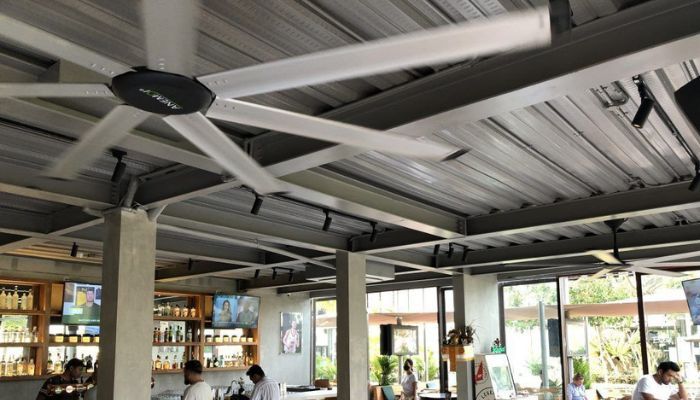
One of the issues of greatest concern to those who decide to start a business, regardless of the size of their facilities, is how to air-condition the business with HVLS fans.
The main controversy lies in the fact that many of them are not aware of the benefits offered by the different air conditioning systems that best suit the characteristics of the building.
Therefore, in Magnovent, specialists in air conditioning of buildings such as offices, restaurants, industrial buildings, production factories or shopping centers, among others, we choose the best system for both the installation itself and for the welfare of its occupants: HVLS fans.

HVLS fans vs. air conditioning systems
Unlike conventional air conditioning (HVAC) systems, HVLS fans not only regenerate the air in the room, but also clean and keep it free of dust and possible contaminating particles, thus protecting the occupational health of workers.
The following are the main differences between HVLS fans and the traditional air conditioning system:
- Operation: HVLS fans operate through large volumes of air at low velocity, creating a continuous flow of air and generating a breeze that allows the evaporation of sweat from the human body. Whereas traditional air conditioners cool or heat the air, through a cooling or heating cycle. These reduce the air temperature by extracting heat and also control humidity, a key factor for the thermal sensation.
- Energy efficiency: HVLS fans cover large areas with very low energy consumption, making them the ideal choice in large spaces. Air conditioning, however, consumes more energy and requires compressors, fans and refrigeration cycles to cool the air. Traditional air conditioning is ideal for small, enclosed spaces.
- Thermal sensation: while VHLS fans do not lower the air temperature, traditional air conditioning provides a cool sensation due to the reduction of ambient heat.
- Environmental impact: traditional air conditioning has a higher environmental impact due to refrigerant gases and high electricity consumption, while VHLS fans are more sustainable because they use less energy.
- Humidity control: VHLS fans do not control ambient humidity although they can prevent humidity buildup in certain areas. However, air conditioners can remove humidity during the cooling process, which is beneficial in humid climates. Or it is a disadvantage in dry climates where it can cause dryness.
HVLS fans to air-condition your business
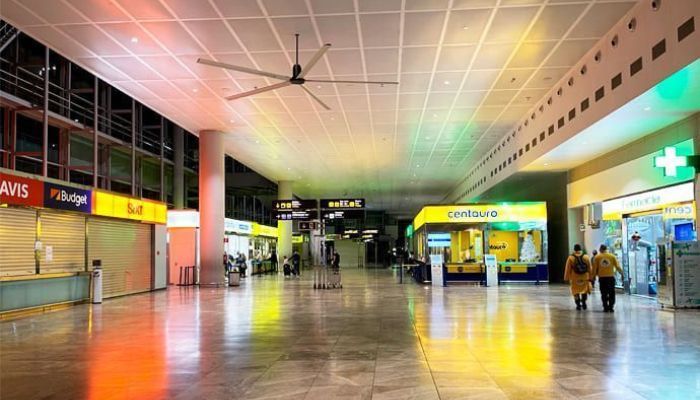
HVLS fans feature High Volume Low Speed (HVLS) technology, moving large masses of air at low velocity in spaces with very high ceilings. Their blades generate a solid column of air that moves in all directions, creating a large horizontal column that eventually circulates the air upwards vertically and back down from the top of the fan. This provides constant temperature control, improved airflow and circulation, and efficient use of energy.
Can HVLS fans be combined with conventional air conditioning (HVAC)?
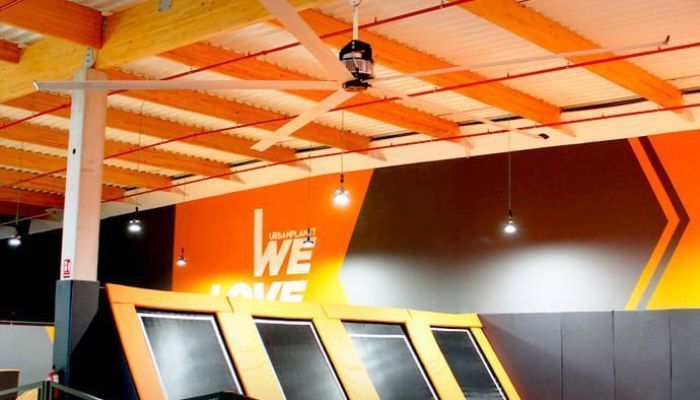
Also, you should know that if your local already has a conventional air conditioning system (HVAC), you can combine it with HVLS fans to maximize their performance. For the air flow enhanced by the fans complements the cold air cooling processes provided by the air conditioners, moving evenly throughout the building space and making the HVAC system does not have to work so hard.
