
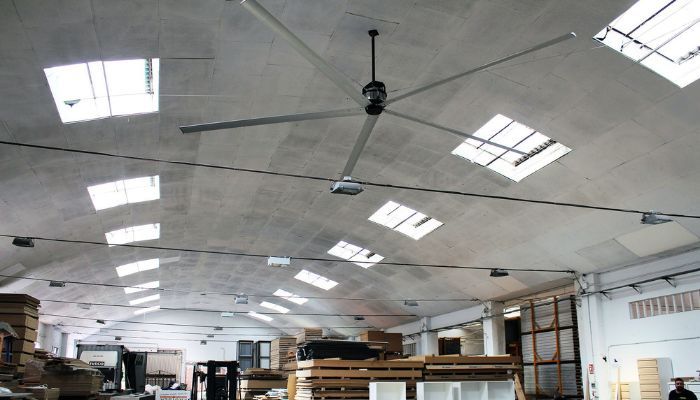
Many foodstuffs are lost over time due to poor thermal conservation in warehouses and refrigeration chambers. Especially in the case of perishable foodstuffs, the slightest error in temperature maintenance can mean a financial loss for many companies. Therefore, it is essential to maintain the storage temperature of perishable foodstuffs.
What factors influence storage temperature of perishable food in large warehouses?
Many warehouses and storage rooms can be very challenging to maintain temperature and good thermal conditions for the storage of products. Among other factors, the following can be affected:
- Lack of thermal insulation.
- Frequent ingress of hot air due to constant door opening or personnel traffic.
- Excess humidity and condensation.
- Poor cold air distribution in large spaces or high ceilings.
- Use of conventional air-conditioning systems with high energy consumption that are inefficient over time.
Faced with these factors, it is necessary to implement solutions that allow ventilation and maintain thermal conditions in warehouses and conservation chambers that store products, especially perishable products.

Importance of proper storage temperature of perishable foodstuffs
Maintaining the cold chain is key to ensure optimal preservation of products in general. However, perishable foods need more attention, as they must always be kept cold at a temperature of between 0 and 8 ºC. In environments where temperatures are too high or even a minimal variation in temperature can lead to a significant loss of products and shelf life.
Having greater control over the storage temperature of perishable foods allows:
- Avoid wasting food through spoilage.
- To reduce health risks and possible poisoning.
- Comply with health and food safety regulations.
Efficient solutions to properly maintain the storage temperature of perishable foodstuffs
To ensure optimal humidity-free ventilation and pest control in food storage areas, the HVLS fan system is the most efficient solution, displacing large volumes of air powerfully in order to maintain similar temperature levels at all times, thus prolonging the shelf life of the products.
HVLS industrial fans can also be used in combination with vaporisation systems to increase their effect, distributing the air throughout the building and creating a gentle, constant and turbulence-free breeze.

What advantages do HVLS fans offer in maintaining the storage temperature of perishable foodstuffs?
The installation of an HVLS fan in food storage areas offers the following advantages:
- They use 30% less energy than a conventional air conditioning system. Discover tips on how to reduce energy consumption in your SME.
- They generate cooler, more uniform air throughout the facility, thus reducing the rapid deterioration of products.
- By eliminating the gears, friction noise disappears,making it the quietest line of HVLS fans.
- The clever open vortex design at the tip of each blade displaces air inwards to cool the electric motor with each turn.
- Unlike conventional fans, it does not require any maintenance.
HVLS industrial fans are a smart investment to keep products fresher for longer, reduce spoilage and save on cooling and heating costs.
