
Offices are spaces where workers spend most of the day, and that’s why knowing how to ventilate an office is vital to ensure the best possible working environment and also to improve employee performance. So, how should ventilation be in an office? We’ll explain it below!
The importance of ventilation in an indoor space
Maintaining good air quality in an indoor space is essential to ensure a healthy environment. In many cases, poor air quality, caused by the lack of efficient ventilation systems in workplaces such as offices—is the main source of health issues and employee discomfort. Therefore, to ensure occupational health, optimal ventilation and air renewal in office interiors is fundamental.
According to Annex III of BOE-A-1997-8669, the working temperature for sedentary activities should be between 17°C and 27°C. If we add to this the Provision 19915 of BOE No. 298 of 2009, which states that in summer no air conditioning system can be set below 26°C, we are left with a one-degree range in which we can maintain our offices.
Can I achieve a lower temperature with ceiling fans?
While it is not possible to reduce the temperature using fans alone, by using directional industrial fans or ceiling fans we can reduce the perceived temperature in the office by several degrees. While ceiling fans act over large areas, directional industrial fans allow the airflow to be directed toward specific zones. In the following HSE diagram, it can be seen how adjusting air speed can improve thermal comfort by several degrees.
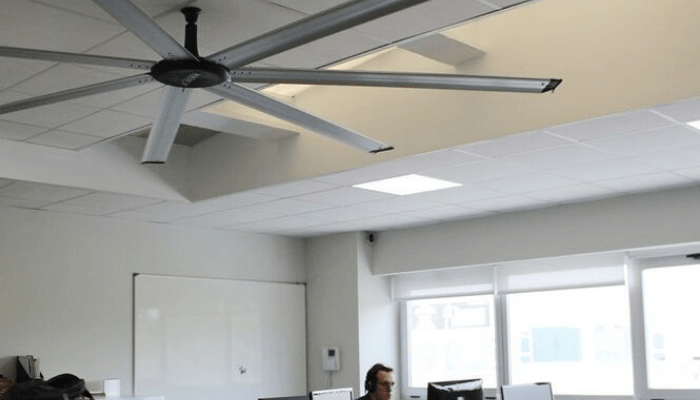
For example, if we set the air conditioning temperature to the legal minimum of 26°C, with an airflow speed of 0.75 m/s from ceiling fans for offices, we can achieve a perceived temperature of approximately 23.5°C.
Having an integral and efficient solution such as our HVLS industrial fans will allow you to achieve a fresh atmosphere free of pollutants. Installing HVLS fans in an office offers the following benefits to both the company and its employees:
- Increase employee productivity: When the room temperature is too high or the ventilation is inadequate, productivity can drop by up to 10%.
- Energy savings: Thanks to their revolutionary motor technology, these powerful fans move large volumes of air using 50% less energy compared to conventional ventilation systems.
- Lower energy bills: HVLS fans have a lifespan of 50,000 hours with no maintenance required, making them a reliable solution that saves money in the long term.
- Silent operation: Their quiet performance and customizable color options allow them to blend seamlessly into any office design.
- Constant air renewal: HVLS industrial fans improve air quality and make it as pleasant as possible, creating a fresh and ideal work environment for occupants.

What are the best ceiling fans for offices?
In larger areas where several employees work, the best option is the HVLS industrial fans from our catalog. These fans are designed to move large volumes of air at low RPMs, providing constant breezes while consuming very little energy.
If office windows are open, HVLS fans ensure constant air renewal. Their silent operation and simple design allow them to be easily integrated into any office with sufficient space for proper installation.
These fans can also be used in winter, especially in offices with high ceilings where heating-generated warm air accumulates at the top. By activating the reverse mode, the fan circulates the air throughout the space, distributing heat evenly and quickly reaching a comfortable temperature at ground level—saving on heating by allowing it to remain off for longer periods.
In enclosed offices and meeting rooms, what is the best ventilation option?
In smaller and more enclosed spaces, such as offices or meeting rooms where natural ventilation is not feasible, the best option is to implement ventilation systems such as exhaust fans, HVAC systems, or air purifiers. Below, we explain each one to offer the most efficient solution tailored to each space’s needs:
- Exhaust fans: These remove stale, humid, or contaminated air from enclosed spaces. They extract indoor air and expel it outside, facilitating air renewal in the office. They also help prevent moisture and bad odors.
- HVAC systems: These integrated systems combine heating, ventilation, and air conditioning. They not only ensure a comfortable temperature but also circulate and refresh the air. Their ductwork allows for filtered air distribution, and their high-efficiency filters eliminate pollutants and allergens.
- Air purifiers: These devices remove airborne contaminants using HEPA filters that trap fine particles such as dust, pollen, smoke, or other pollutants. They improve air quality and reduce health risks for office workers, especially in small, enclosed rooms.
Thermal insulation as a complementary measure for office ventilation
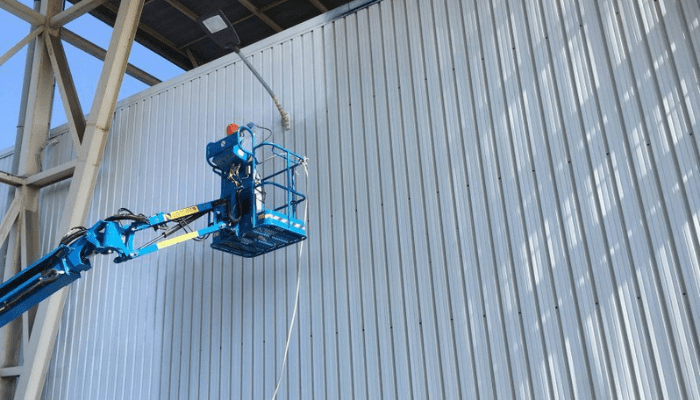
Regardless of the chosen ventilation solutions, buildings such as industrial warehouses with asbestos or metal roofs often suffer from internal heat due to solar radiation. A first step to prevent this is to properly insulate the entire building.
At Magnovent, we recommend our ceramic thermal insulation. It is composed of ceramic microcapsules with vacuum interiors. These vacuum capsules do not conduct heat and therefore provide thermal insulation between the exterior and interior of the building. Applied like paint on any surface—in this case, the building’s façade or roof—it can reduce heat transfer to the interior by up to 70%.
In short, knowing how to properly ventilate an office is essential for ensuring a healthy and productive work environment. Proper air quality and good airflow are key factors for employee well-being. At Magnovent, you’ll find ideal solutions such as HVLS industrial fans and thermal insulation to help you make a difference and create a comfortable workspace.
