
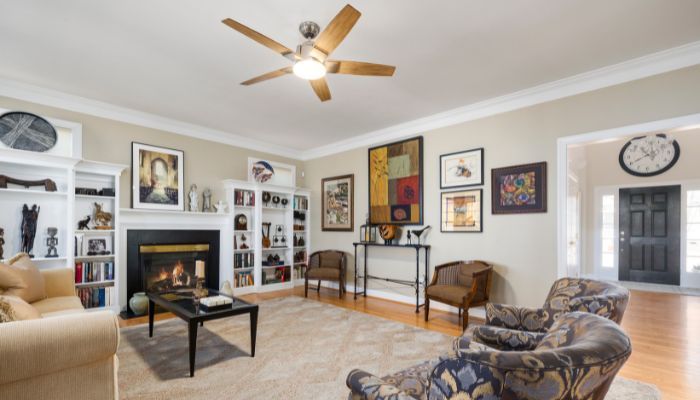
Ceiling fans are the ideal choice for keeping the home cool and creating a pleasant atmosphere in the warmer months. However, the most frequently asked question for many is how much power does a ceiling fan consume?
Find out in this article a detailed overview of the energy consumption of fans and how to reduce it with the reverse mode.
Types of ceiling fans
There are different models of ceiling fans to suit different needs and lifestyles. In the Magnovent catalogue you will find the following models:
Ceiling fans with LED light
Ceiling fans with LED light incorporate lamps in their design to give the fan multi-functionality in different rooms that require additional lighting.
Ceiling fans without light
At Magnovent we have ceiling fans without light such as the Boreas model. This fan has a silent function thanks to its direct current (DC) motor and is a perfect choice for those environments that require high demands.
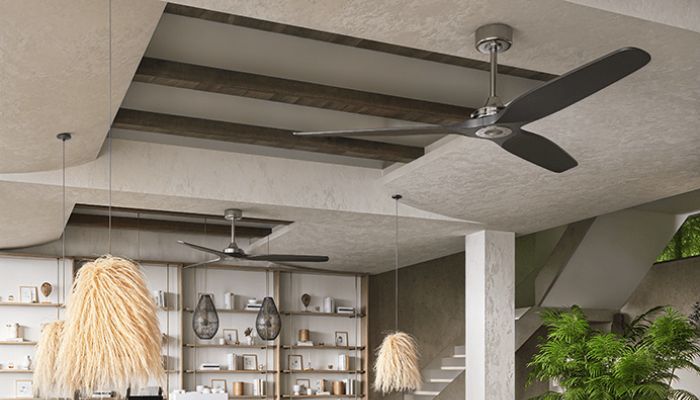
Advantages of ceiling fans
Ceiling fans are the best option for your home, not only because they are an economical choice, but also because they are an efficient way to improve comfort throughout the year. If you are wondering how much a ceiling fan consumes, you will discover that they offer different advantages that we detail below:
Air movement
Ceiling fans do not cool or heat the air directly, but move and distribute the air throughout the room while maintaining the temperature and without removing humidity. As they do not dry out the air, fans also become the best solution for people with respiratory problems or who require a more natural climate.
Combinable with other air-conditioning systems
Fans are allies of air conditioning and heating and help to better distribute cool or warm air. This results in significant energy savings by reducing the demand on air conditioning or heating performance.
Usability all year round
Ceiling fans with reverse mode allow warm air to be moved downwards during the winter and cool air in the summer months.

How much does a ceiling fan consume?
Now that you have been introduced to ceiling fans, how much energy does a ceiling fan consume? The energy consumption of a ceiling fan depends on different factors such as the power of the motor, the speed at which it is used and the time it remains in operation.
The average power consumption of a ceiling fan is between 15 and 70 watts (W) depending on its speed and model. Unlike an air conditioner which consumes between 1000 and 2000 W.
As you have seen, ceiling fans use far fewer watts than other ventilation systems, so you will reduce costs considerably. There is no set consumption, as this will depend on other factors as mentioned above.
If you want to calculate how much a ceiling fan consumes, you must first calculate the result of the energy consumed in kilowatt hours. Once you have calculated the consumption in kilowatt hours, you must multiply it by the price of electricity to obtain the daily cost in euros.
If, on the other hand, you want to calculate how much an air conditioner consumes, you will have to perform the same calculations.
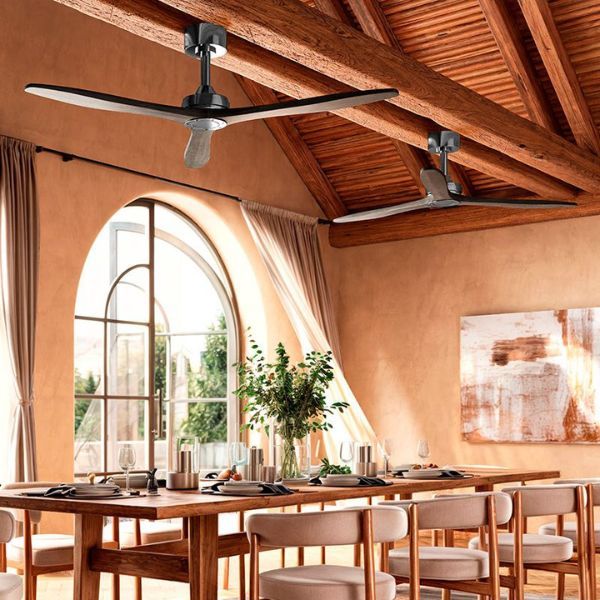
Ceiling fan vs. air conditioning
Both air conditioning systems help to combat the heat during the summer months. However, it is important to consider the advantages and disadvantages of each of these air conditioning systems:
- The initial investment is lower for ceiling fans, as models with DC motors are available at affordable prices.
- The monthly electricity consumption is minimal in contrast to other air conditioning systems.
- The fans can be used during the night, as they do not make noise.
- They do not dry out the air, so they prevent sore throats, muscle aches, headaches and colds.
- However, fans do not cool the air, they simply move and distribute it by generating air circulation.
Reduce air conditioning or heating consumption with the reverse mode
In addition to knowing how much a ceiling fan consumes, at Magnovent we give you some tips to reduce the consumption of the different air conditioning systems with the reverse mode of the ceiling fans.
During the hottest months of the year, the fan should rotate forward (counterclockwise). This creates an air current that, combined with the body’s natural perspiration, generates a cooling effect that relieves the sensation of heat.
On the other hand, during the coldest months of the year, ceiling fans become great allies. With these, warm air can be distributed with the blades rotating clockwise throughout the room. This allows the heat not to condense in the upper parts of the room and also to be distributed towards the floor.
