
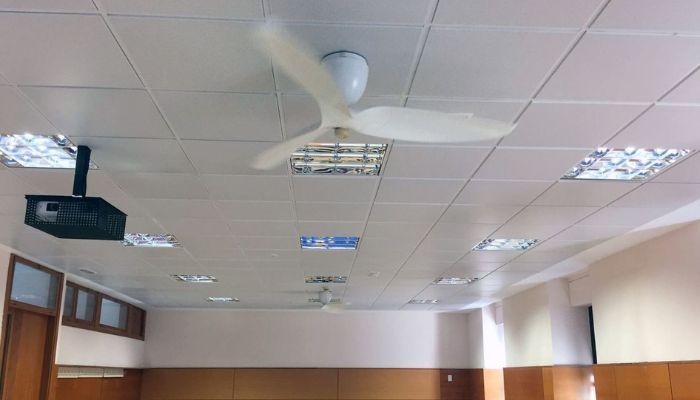
With the arrival of hot weather, you may be thinking about how to cool your home, office, warehouse, etc. If you are wondering which are the best ceiling fans, below we explain the key factors to consider and help you choose the best option for your needs.
Magnovent ceiling fans enhance the appearance of a space and help you save on your electricity bill, improving your comfort while contributing to a more sustainable environment. Our wide range of ceiling fans includes different models to suit a variety of needs.
Best ceiling fans: What are the different types like?
Choosing the best ceiling fan for your space — whether a home, office, warehouse or other area — can be a difficult task. To make the selection easier, we recommend considering several factors:
- Consider the required coverage to determine where you want to install it.
- Your preferred style and material.
- Whether you need a fan with or without a light.
- Connectivity and smart control requirements.
- The energy consumption and noise level of each model.
Below is a summary table showing the main features of the best Magnovent ceiling fans, followed by a more detailed explanation of the most important factors to consider:
| Boreas | Cefiro | Airlux | |
|---|---|---|---|
| Photos | 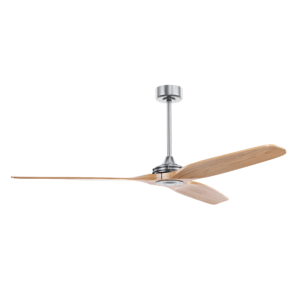 |
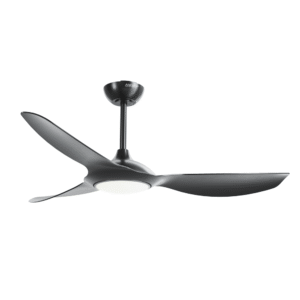 |
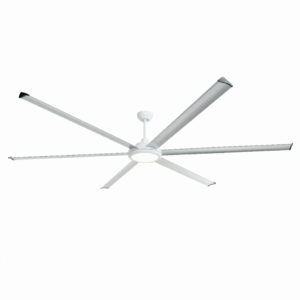 |
| Who is it for? | Fans of modern design | Suitable for all kinds of needs | Fans of industrial design |
| Why we recommend it? | Low consumption and noise | Ultra-quite | Great versatility |
| Where to install it? | Indoor and covered outdoor areas | Indoors | Indoor and covered outdoor areas |
| Coverage | 62 m² – 111 m² | 25 m² – 35 m² | 42 – 93 m² |
| Material | Wood | ABS plastic | Aluminium |
| Control | Remote control and Wi-Fi with timer | Remote control and Wi-Fi with timer | Remote control and Wi-Fi with timer |
| LED light | Available with or without LED light | Available with or without dimmable LED light | Available with or without dimmable LED light |
Ceiling fans with or without LED lights
Ceiling fans with lights are ideal for replacing a conventional lamp, as they can be installed in the centre of the room to provide lighting while distributing air evenly. In addition, ceiling fans with LED lights can help you save up to 80% on energy consumption.
Ceiling fans without LED lights, on the other hand, are available in a wider variety of sizes, making them suitable for both smaller and larger rooms. They are also ideal for patios, terraces or porches where integrated lighting is not required.
Ceiling fans with DC or AC motors
Ceiling fans with AC motors (alternating current) are the most common and economical models. However, ceiling fans with DC motors (direct current) are more energy-efficient, quieter and offer a wider range of speed settings. At Magnovent, we choose DC motors to help our customers achieve optimal ventilation while making significant energy savings.
Ceiling fans with blades or retractable blades
Traditional ceiling fans with blades provide greater coverage and airflow. The amount of air they move varies depending on the size of the blades, their angle and the rotation speed. This makes them ideal for medium-sized and large spaces.
Retractable ceiling fans, on the other hand, are an innovative option that is becoming increasingly popular thanks to their attractive design and functionality. They help save space and operate quietly, although their lower power makes them particularly suitable for smaller spaces.
Advantages of ceiling fans
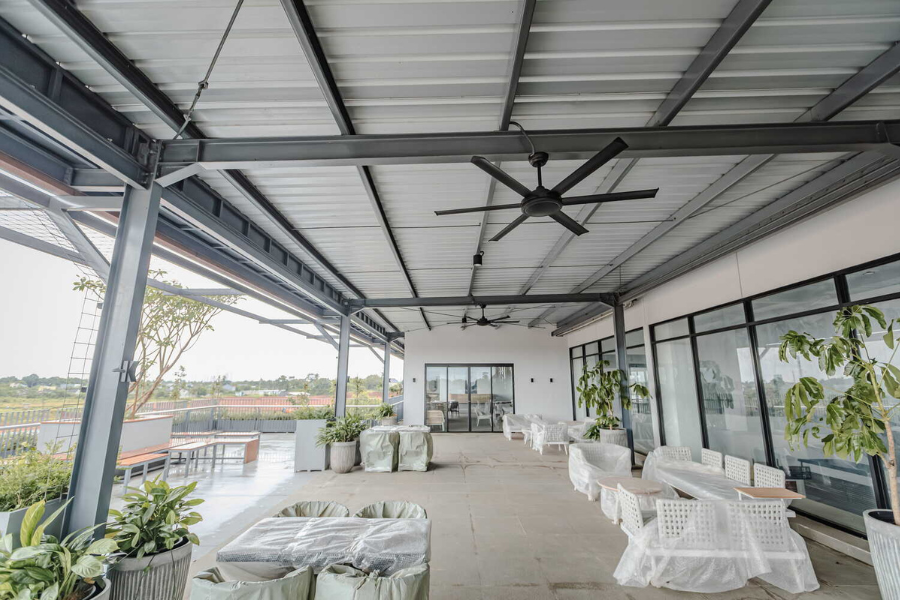
Ceiling fans not only allow cooling spaces or maintain good ventilation, but offer other benefits, either combined with other air conditioning systems or as the main source of ventilation. Here are the different advantages to choose the best ceiling fans for your home or business:
- Most economical: both in initial price and energy consumption, ceiling fans are the most economical models on the market.
- Quieter: unlike other fans, these fans are quieter, making them the ideal choice when it comes to installing them in a room without disturbing sleep.
- Better air distribution: Ceiling fans are usually used to cool the environment in summer, but also help distribute the warm air that accumulates on the ceiling during the winter months.
- More sustainable: ceiling fans can reduce the need for air conditioning and heating systems, helping to lower carbon emissions and environmental impact.
- Better integration into homes or businesses: ceiling fans integrate seamlessly into the design of a room and avoid some of the inconveniences associated with pedestal fans, such as floor space requirements and the need for a nearby power outlet.
How to choose the best ceiling fans?
As we have seen, choosing the ideal ceiling fan for your room is not always easy. Several factors need to be considered to optimise its performance and ensure that it fits well with the existing design. Room size, noise level and available features are some of the key characteristics to consider when choosing among our best ceiling fans.
Room and fan size
It is very important that the size of the fan is proportional to the size of the room in order to ensure proper air distribution. If the fan is too small, the airflow may be insufficient, while a fan that is too large may create excessive airflow or look disproportionate in the space.
Ceiling height is another important consideration, as it will help determine which fan is most suitable. The blade size is just as important as the length of the downrod, as a longer downrod can position the fan lower in rooms with high ceilings and improve air circulation.
Number of blades
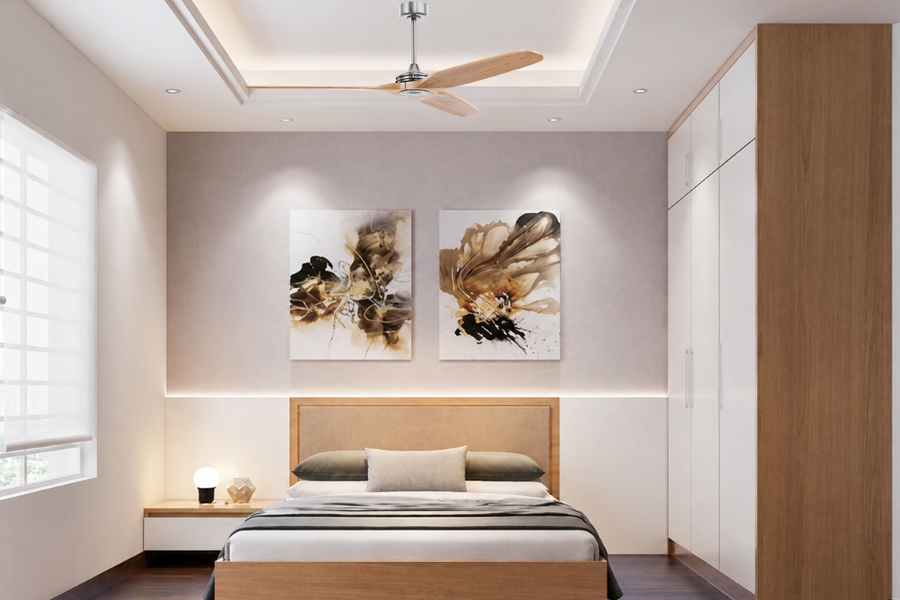
The number of blades affects both fan efficiency and aesthetics. Fans with more blades tend to operate more quietly, although they generally move less air.
- Fans with 3 blades: allow greater air circulation and are the best choice for large rooms or high ceilings.
- Fans with 4 or 5 blades: they are more aesthetic and move the air in a lighter and quieter way.
- Fans with retractable blades: Ideal for those looking for modern aesthetics and correct air circulation efficiency.
Noise
The noise level is a key factor when choosing a ceiling fan, especially if it will be installed in bedrooms, offices, living rooms or other spaces where quiet operation is important.
Magnovent ceiling fans feature DC motors (direct current), which are much quieter than AC motors (alternating current), while also consuming up to 70% less energy.
Reverse mode
The reverse mode is a very important function, as it allows the fan to be used all year round. In summer it allows to create a greater sensation of coolness and reduce the ambient temperature, while in winter the blades rotate in the opposite direction pushing the hot air accumulated in the ceiling downwards, keeping the heat.
Lighting
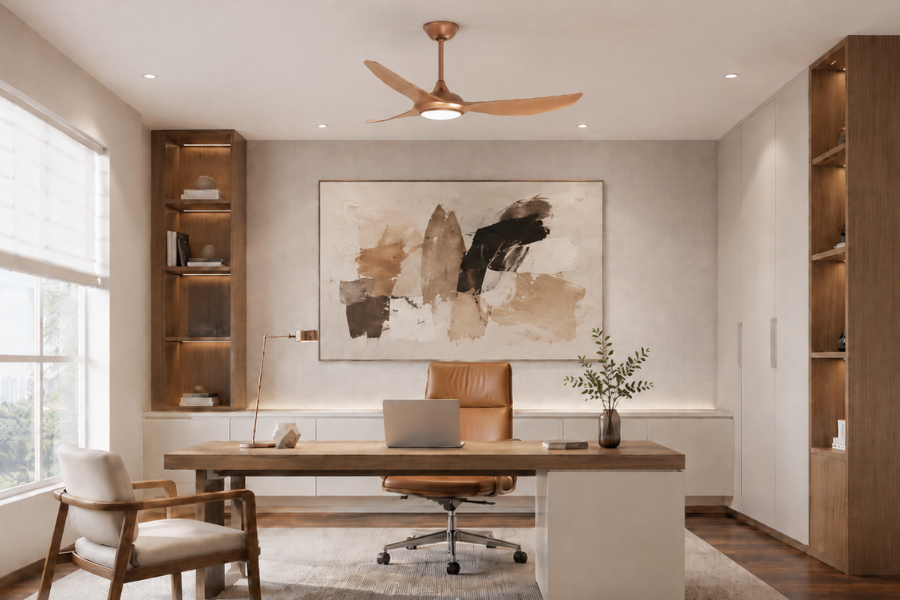
If you need a ceiling fan that also acts as a light source, Magnovent ceiling fan models with integrated LED lighting are an ideal option. They consume less energy and have a longer lifespan than conventional light bulbs.
Smart features
Magnovent ceiling fans are characterised by their advanced technology and connectivity. You can control your fan at home using the remote control or manage it from anywhere through its Wi-Fi module and the Tuya Smart app. You can also control your fan by voice using Alexa or Google Assistant.
Another useful feature is the ability to schedule its operation. For example, you can leave the fan running when you go to sleep knowing that it will switch off after a few hours, or schedule it to turn on before you arrive home so that the space has already been ventilated.
Consumption
To reduce your environmental footprint while also saving on your energy bills, ceiling fans with DC motors offer greater efficiency and lower consumption than fans equipped with AC motors. Studies show that DC ceiling fans can consume up to 70% less energy than models with AC motors.
In short, to choose one of the best ceiling fans, it is very important to take into account the aspects mentioned above. By paying attention to these aspects you will not only get a correct air circulation, but you will also get a more comfortable, economical and sustainable environment without leaving aesthetics aside.

Conclusion: which is the best ceiling fan for you?
Choosing a ceiling fan may seem complicated given the wide range of options available on the market today and the many features they can offer. However, by considering the different factors discussed above, you can make a more informed choice and find the right fan for your space.
If you are still unsure which model is best for you, our customer service team will be happy to answer your questions. Contact our technical team and we will recommend the most suitable option for your needs.
Frequently asked questions about ceiling fans
When choosing and installing a ceiling fan, more specific questions may arise regarding its operation, maintenance or installation. Below, we answer some of the most common questions to help you get the most out of this ventilation system and choose the most suitable solution for each space.
