

Industrial ventilation is a key factor in the efficiency and safety of large workplaces.
In this article, we will discuss industrial ventilation systems and the different models available, as well as how their implementation benefits workers.
What is an industrial ventilation system?
Industrial ventilation in large workplaces reduces the emission of unpleasant odors, dilutes the concentration of possible air pollutants and maintains good temperature and humidity conditions for both employees and stored material in large facilities.
Types of industrial ventilation systems
There are different industrial ventilation systems such as:
Comfort ventilation
This type of ventilation allows to create a good working environment achieving an adequate air conditioning, depending on the season of the year or the location area. This benefits the health of the workers and consequently the production of the tasks in a comfortable way.
Evacuation ventilation
Evacuation ventilation requires the removal of a large volume of stale air in areas with a more polluted environment.
Forced ventilation
This industrial ventilation system allows to ventilate enclosures where natural air does not easily enter or is not accessible. Forced ventilation allows fresh, clean air to be brought into the enclosure by means of air conditioning systems designed for this purpose.
Suppression ventilation
In a large enclosure, suppression ventilation seeks to bring in outside air with higher pressure in a more natural way, allowing for greater airflow.
Why is it important to have an industrial ventilation system?
Industrial ventilation plays a crucial role in the air quality of large workplaces. When the air in a workplace is polluted, the well-being of workers can be affected. In addition, a good industrial ventilation system allows:
- Purify the air: Contaminants such as smoke, dust, odors, noxious gases, unpleasant smells, excessive humidity, among other elements that can affect health, are eliminated.
- Improve air quality: Continuous air renewal ensures a healthier and more comfortable indoor environment.
- Ventilation control: In an enclosed space, air extraction systems allow for increased ventilation, good air flow and avoid accumulation of contaminated air or lack of oxygen.
- Regulated temperature: An adequate ventilation system allows for good temperature regulation in interior spaces.
- Reduction of air conditioning costs: Recovery systems allow thermal energy to be reused during ventilation, thereby reducing the load on heating systems and optimizing the plant’s energy efficiency.
Industrial ventilation regulations
The regulations for industrial ventilation in Spain established by Royal Decree 427/2021, of June 15, guarantees optimum air quality conditions in industrial environments by addressing aspects such as:
- Air renewal
- Elimination of contaminants
- Protection of workers and their health
Industrial ventilation at Magnovent
At Magnovent, we offer sustainable and efficient industrial fan systems to achieve proper climate control in large spaces such as production plants, warehouses, industrial buildings, etc.
Airslim Fan
The Anemoi Airslim fan not only keeps heat and humidity under control, but also protects product quality and increases worker productivity.
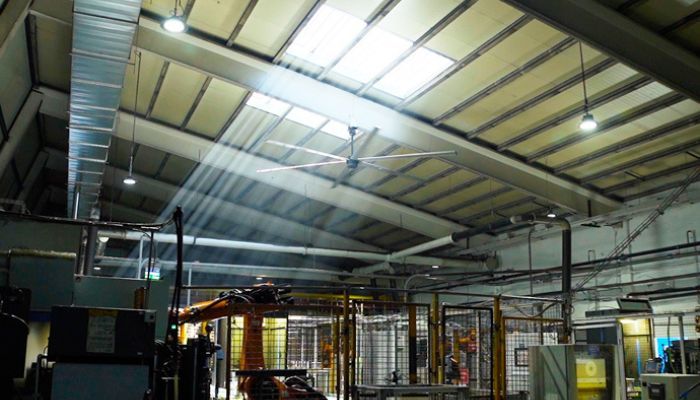
Advantages of industrial ventilation with the Airslim ventilator
- Quiet ventilation: It represents the quietest line of HLVS fans. Noise disappears thanks to the elimination of gears.
- More powerful ventilation: Displaces a large amount of air while using 50% less energy. In addition, its motor allows a 75% more powerful airflow than other fans.
- Intelligent ventilation: Control the speed automatically depending on the temperature thanks to Magnocontrol 10, which makes it possible to easily integrate all building systems and operate them from the ground.
- Safe ventilation: It has an industrial quick-mount bracket and uses a safety blade retainer.
