
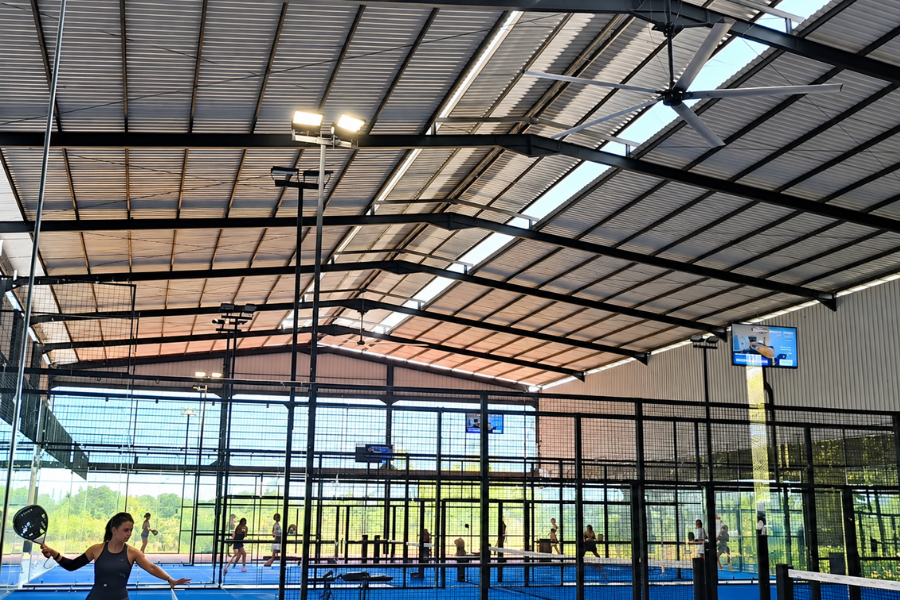
The world of padel has experienced continuous growth in recent years. This has driven the development of increasingly large padel clubs and sports facilities. In these environments, having suitable padel court climate control systems is essential. Magnovent’s bioclimatic solutions are designed to provide thermal comfort for both players and spectators.
Maintaining appropriate climate conditions in indoor and semi-open padel courts helps improve air circulation and create a more comfortable environment. In addition, padel court ventilation solutions can move large volumes of air in a wide, even and controlled manner.
The challenges of padel court climate control: Improving comfort for players and spectators
Maintaining suitable thermal conditions in a padel club can be challenging. The characteristics of these facilities, combined with the physical activity of players, make it difficult to control temperature, humidity and air movement.
The main challenges of padel court climate control include:
- High ceilings: Warm air tends to accumulate near the ceiling, creating temperature differences between different levels of the facility.
- Large indoor spaces: The larger the space, the more difficult it becomes to maintain consistent thermal conditions across all courts and occupied areas.
- Extensive playing areas: Air must be distributed evenly across the different courts, avoiding areas with insufficient circulation.
- Indoor and semi-open facilities: Openings, building orientation and outdoor conditions directly influence temperature and airflow patterns.
- High temperatures and humidity: Insufficient air circulation can increase the feeling of heat and reduce comfort during play.
- Intense physical activity: Players generate considerable body heat during exercise, meaning their thermal comfort needs differ from those of spectators.
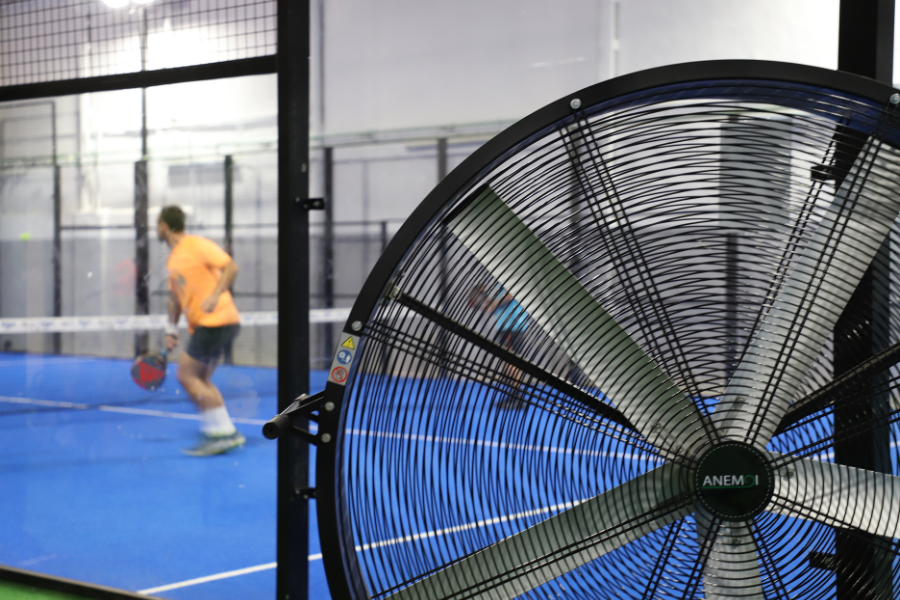
Air Movement: Its influence on player and spectator comfort
The thermal sensation experienced by players and spectators depends on more than just ambient temperature. Several factors influence thermal comfort on a padel court. The main ones include:
- Air temperature: Directly influences how warm or cold people feel inside the facility.
- Relative humidity: High humidity levels make it harder for sweat to evaporate and can increase the sensation of heat, especially during physical activity.
- Air speed: Air movement across the skin promotes sweat evaporation and body heat loss, helping improve thermal comfort.
- Mean radiant temperature: Heat radiated by roofs, walls and other surfaces also affects comfort, even when the ambient temperature is not particularly high.
- Physical activity and clothing: Thermal comfort requirements vary depending on the level of physical effort and the clothing worn. As a result, players and spectators may experience different thermal sensations within the same space.
It is essential to consider factors such as temperature, humidity, air movement and airflow distribution when planning and designing the most suitable climate control solutions for padel courts and clubs.
How do HVLS fans improve padel court climate control?
HVLS industrial fans (High Volume, Low Speed) are designed to move large volumes of air at low speeds. Thanks to their large diameter, they generate a wide airflow that moves down from the upper part of the facility and spreads throughout occupied areas.
In large sports facilities, using numerous conventional fans can create highly localised air currents while leaving other areas with insufficient circulation. HVLS fans offer a different approach: moving air evenly and in a controlled manner across large areas using fewer units.
In a padel club, this technology can offer several advantages:
- Greater coverage: A single fan can cover a large area.
- More even air distribution: Helps reduce areas with insufficient air movement.
- Fewer units required: Can reduce the need to install numerous smaller fans.
- Quiet operation: An important factor in avoiding disruption during play.
- Overhead installation: Fans can be installed at height, making use of the upper structure of suitable facilities.
The goal is not to create strong draughts directly over players, but to achieve continuous and controlled air movement that improves thermal comfort across the different courts and areas of the club. The most suitable solution will always depend on the dimensions, ceiling height, court layout and specific characteristics of each facility.
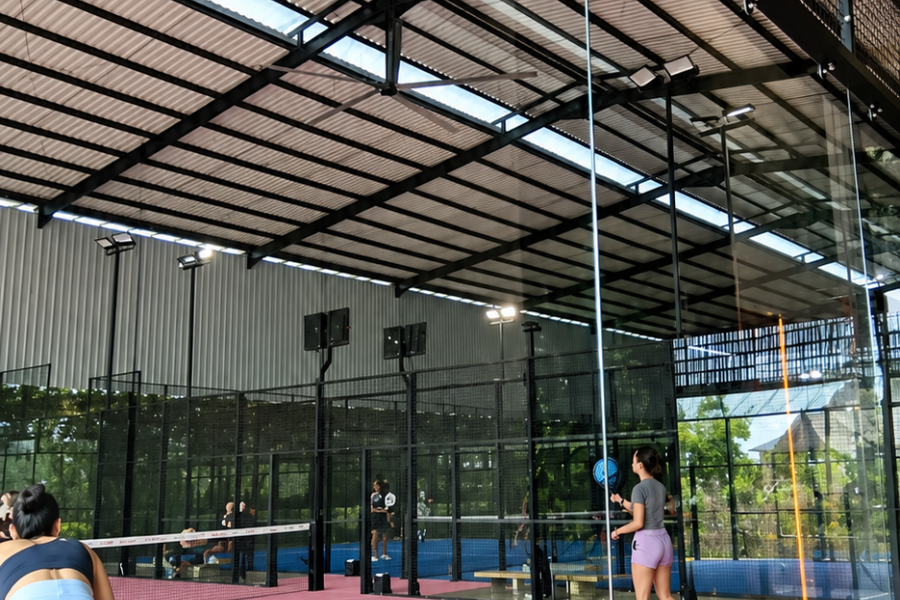
Want to improve ventilation on your padel courts?
Climate control and ventilation requirements vary depending on the type of padel facility. A fully enclosed court behaves differently from a semi-open space or a completely outdoor court in terms of thermal conditions.
For this reason, before choosing a solution, it is important to identify how much control can be exercised over the environmental conditions. When considering padel court climate control, we can distinguish between three scenarios:
Benefits of effective climate control in a padel club
A properly designed climate control strategy can improve the experience of both players and spectators. At the same time, implementing suitable padel court climate control systems helps optimise the operation of the club’s existing facilities.
The main benefits include:
- Greater comfort for spectators: Proper air distribution also improves conditions in spectator stands, waiting areas and other spaces near the courts.
- More even air and temperature distribution: A properly sized installation helps reduce stagnant air and limit excessive draughts. This contributes to more consistent thermal conditions across different areas and heights within the club.
- Integration with other climate control systems: HVLS fans can complement systems such as air conditioning, helping distribute conditioned air more effectively.
- Greater energy efficiency: Suitable climate control systems can help avoid unnecessary equipment use and optimise the facility’s energy consumption.
- More unobstructed space: Solutions such as HVLS fans are installed overhead, keeping areas around the courts clear and making better use of the available space.
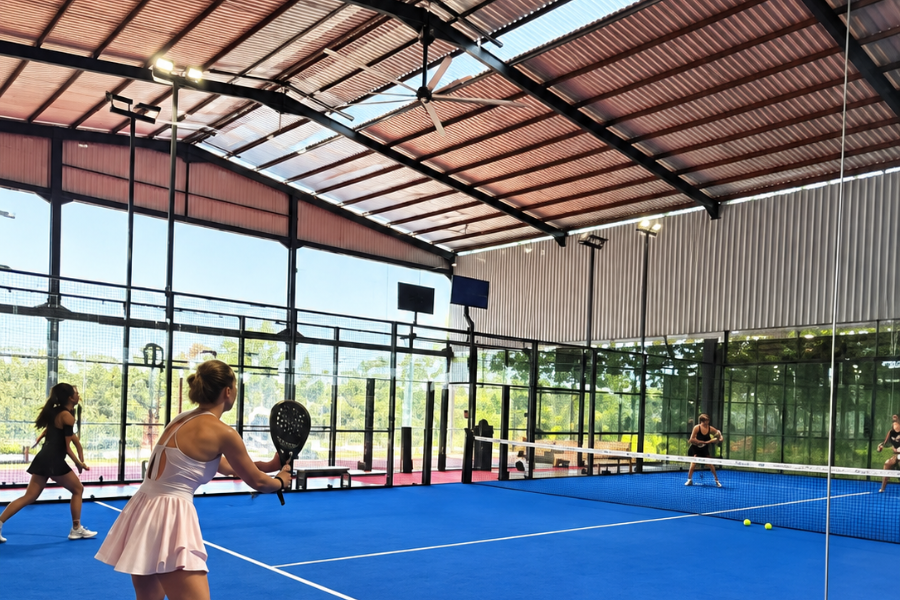
Padel court climate control projects by Magnovent
The international growth of padel has led Magnovent to develop padel court climate control projects for clubs and sports facilities. Our goal is to adapt bioclimatic architecture solutions to the specific characteristics of each space.
One example is the successful project carried out at Pro Padel, where HVLS fans have been installed to improve air circulation and enhance thermal comfort on the playing courts.
In these projects, we analyse factors such as available ceiling height, the area to be covered, court layout and airflow patterns before determining the number and position of the fans. This approach allows us to design a solution tailored to the facility rather than simply selecting an individual fan.
Why choose Magnovent for your padel club climate control?
Industrial ventilation in a sports facility depends on more than just the type of fan selected. Its location, diameter, installation height and operation directly influence how air reaches players and spectators.
At Magnovent, we approach every installation as a complete project:
- Facility assessment: We analyse dimensions, ceiling height, court layout and environmental conditions.
- Air distribution design: We determine the most suitable fan locations to achieve adequate coverage.
- HVLS fans: We work with solutions designed to move large volumes of air at low speeds.
- Integration with other systems: We assess how our solutions can work alongside existing climate control systems when necessary.
- Fan control: We adapt fan operation to the actual requirements of the facility.
- Experience in sports facilities: We implement ventilation solutions in padel clubs and other sports facilities.
Want to improve ventilation on your padel courts?
Whether you are designing a new padel club or looking to improve an existing facility, our technical team can help you develop an air movement strategy tailored to your club’s specific needs. At Magnovent, we can assess your facility to determine how to distribute air, which equipment to use and where to install it.
We specialise in climate control and ventilation for sports facilities, developing solutions tailored to the specific characteristics and requirements of each installation. Our mission is to help you improve thermal comfort for players and spectators while optimising energy efficiency.
Frequently asked questions about padel court and club ventilation and climate control
When planning ventilation and climate control for a padel club, several questions may arise. Below, we answer some of the most common questions to help you understand which factors should be considered before choosing a climate control solution for padel courts.
