
Hangars are large, high-ceilinged halls located on airfields, which are generally used for both aircraft storage and routine maintenance. But how to air condition a hangar? Due to the natural characteristics of this type of facility, achieving optimum ventilation and air conditioning throughout the year is a challenge. So, in response to this problem, at Magnovent we offer an integral and efficient solution through HVLS fans.
How to air-condition aircraft hangars?
It is important to know how to air-condition hangars, as these spaces are susceptible to high temperatures which can lead to uncomfortable working conditions and other complications.
At Magnovent we are constantly working to develop innovative solutions to obtain the best comfort in different industrial environments. Therefore, for the correct air conditioning of hangars, we present the HVLS industrial fans, which are the most efficient solution for the optimal air conditioning of hangars.
Thanks to the large amount of air moved by the blades of these large fans, uniform air conditioning of the space is achieved, contributing to sustainability and commitment to the environment. They are designed to reduce thermal stratification in large spaces, such as an aircraft hangar. During the colder months, HVLS fans evenly distribute the hot temperature build-up from the ceiling to the floor. During the warmer months, they generate a gentle breeze that can reduce the wind chill by up to 6°C.
HVLS fans not only improve the conditions and environment for hangar workers, but also maintain and protect equipment.

Why is hangar air conditioning so important?
Knowing how to air-condition hangars is essential to understanding hangar performance, safety and comfort:
- Comfort and thermal comfort: these industrial spaces are often exposed to high temperatures due to their large volume and low thermal insulation. Therefore, implementing adequate air conditioning can prevent the appearance of conditions such as fatigue, dehydration or heat stress that directly affect workers, either in their health or productivity.
- Equipment and space protection: different weather conditions such as excessive humidity or lack of air circulation can influence the maintenance or upkeep of aircraft or the wear and tear of different maintenance equipment.
- Increased productivity and efficiency: with temperature control, the potential for human error and mechanical failure is reduced and maintenance tasks can be carried out with greater safety and accuracy.
Advantages of using HVLS fans for hangar climate control
Integrating HVLS fans not only enables hangar climate control, but also ensures a safe, efficient and sustainable environment. Find out more about the benefits of using HVLS fans for hangar climate control below:
- They help to recirculate and renew the air inside the installation.
- Its use increases the well-being and thermal comfort of its users.
- HVLS fans protect your company’s equipment and keep your aircraft in good condition.
- They generate cooler air that is evenly distributed throughout the installation.
- They air-condition the building while reducing energy consumption, as they use 30% less energy than a conventional air-conditioning system.
- They reduce economic costs.
- Our team of experts takes care of the installation and maintenance of HVLS fans.
- By eliminating the gears, the friction noise disappears, making it a completely silent solution.
- They help to minimise unpleasant odours and remove particulate pollutants from aircraft engines.
And in winter, how to air condition a hangar?
To achieve the best air conditioning in hangars during the winter months, we recommend using HVLS industrial fans in combination with our radiant heating system that works by using infrared heat and gas as an economical energy source, through the installation of plates of different intensity placed on the ceiling of the installation.
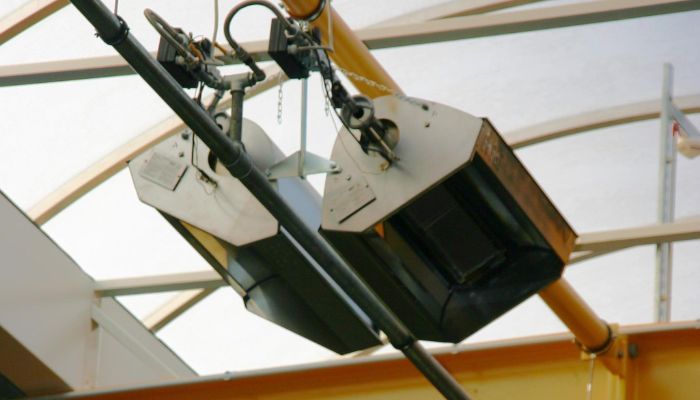
In this case, the fans should be used in ‘reverse’ mode (find out how fans can help save on heating with reverse mode in winter) in order to destratify the stagnant heat in the upper part of the hangar and thus optimally cool the hangar. This combination (HVLS fans and radiant heating) will help to clean the air and evenly distribute the heat throughout the facility, while preventing potential heat loss and contributing to energy savings.

If you are interested in the installation of these air conditioning systems, you should know that Magnovent‘s team of professionals previously carries out a study of optimal coverage according to the space of the installation in which the coverage and placement of the ideal model is shown, as well as detailing theestimated energy savings and payback time of the investment. Contact our team of experts and we will help you define the best solution to air-condition your hangar.
