
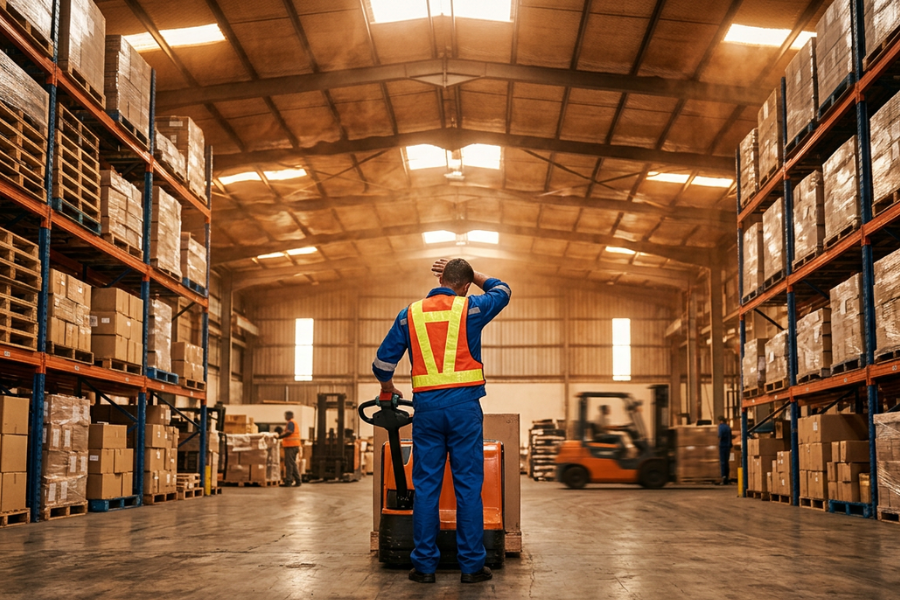
Maintaining efficient operating temperatures in distribution centers and high-bay warehouses has become a critical challenge for companies’ financial viability. During the summer season, direct solar radiation turns the roofs of facilities into massive radiators. The air trapped under the roof absorbs this thermal energy and generates a dense stagnant layer that can exceed 50°C. This phenomenon, known in the industry as the heat plume in industrial warehouses, triggers a process of thermal stratification that overloads cooling systems, increases kW/h consumption, and severely degrades working conditions on the floor.
The Physics of Industrial Thermal Stratification and the Formation of the “Heat Cap”
In thermodynamics, hot air expands, loses density, and naturally rises. In facilities with high ceilings (over 6–8 meters), this physical principle creates a severe thermal gradient, with differences of up to 10°C between the floor and the roof.
There is a widespread misconception that the accumulation of hot air at the ceiling or “heat plume” is a problem exclusive to winter. The physical reality is that industrial thermal stratification occurs 365 days a year; what changes dramatically is how ventilation engineering must manage it depending on the season:
- Winter strategy (Heat recovery): The hot air accumulated at the roof is a valuable energy asset. Destratification systems gently push it back down to the occupied zone, drastically reducing boiler usage.
- Summer strategy (Heat dissipation): The same heat buildup becomes a dangerous thermal waste. The goal is no longer to retain or bring it down, but to break the thermal pocket using large airflows and channel it vertically toward roof vents or extraction systems to expel it from the warehouse.
When this volume of overheated air stagnates in summer, residual thermal radiation is projected downward, continuously increasing warehouse temperatures and forcing HVAC compression systems to operate at their maximum capacity.
Who Is Affected? The Human Factor and the Logistics Bottleneck
The impact of this thermal phenomenon is not uniform; it directly affects the most sensitive links in the supply chain and the plant workforce:
- Picking operators and forklift drivers at height: Personnel operating on upper platforms or in trilateral forklifts are directly exposed to thermal stress in warehouses. Working just a few meters from the roof heat plume, they experience premature fatigue, dehydration, and a 2% loss of cognitive performance for each degree above 24°C, increasing workplace accident rates.
- Stock managers and quality control: Upper shelves of high-bay racking systems are submerged in the highest temperature zone. This compromises the preservation chain of sensitive goods (such as pharmaceuticals, food products, or precision electronics) before cold air from the floor can stabilize the area.
- Operations directors (Operating costs): During heatwaves, the vertical layout of inventory acts as a massive physical barrier that blocks horizontal air circulation or perimeter ventilation flows. Forcing traditional climate systems to break these latent heat pockets only generates unsustainable energy peaks and compressor fatigue failures.
Traditional warehouse climate control systems in high-rise facilities consume up to 30% more energy trying to cool upper layers in summer, as cold air tends to stagnate on the floor due to its higher density, failing to reach critical inventory zones.

Breaking the thermal barrier: Bioclimatic engineering solutions
To solve heat accumulation in a vertical warehouse, it is not necessary to blindly inject more cooling, but rather to apply fluid dynamics principles to intelligently move the existing air volume through an integrated ecosystem of solutions:
1. Industrial HVLS ventilation technology to eliminate the “heat plume”
HVLS ventilation systems (High Volume, Low Speed), such as the Airpro range from Magnovent, are the most efficient destratification tool on the market. Equipped with permanent magnet synchronous motors (EC Direct Drive), these units generate a massive column of air that travels vertically to the floor and spreads 360°, flowing through rack aisles.
Among the main benefits of HVLS fans are the elimination of thermal stratification, improved operator comfort, and optimized energy consumption in large logistics warehouses. These advantages make HVLS technology one of the most efficient solutions for eliminating the heat layer and improving the thermal performance of the facility, as explained below:
- Vertical evacuation and chimney effect: By mechanically breaking the stagnation of the heat plume, HVLS technology enables hot air to be guided and expelled through roof vents or exhaust openings, freeing the structure from thermal inertia.
- Perceived temperature reduction: Continuous air movement at controlled speeds (1–2 m/s) reduces perceived temperature for workers by 4°C to 6°C through natural evaporative cooling, improving comfort without changing actual air temperature.
- Air mass homogenization: Eliminates hot spots at higher warehouse levels, protecting sensitive stock and reducing the load on existing HVAC systems.
2. Free cooling systems and roof vents
Free cooling strategy consists of using favorable outdoor air conditions to naturally cool the indoor space. By combining HVLS ventilation with roof vents or automated dampers, a controlled “chimney effect” is activated: the accumulated heat pocket from the day is evacuated via thermal buoyancy to the atmosphere during night or early morning hours. This allows the warehouse to start the working day completely free of residual heat and with minimal thermal inertia.
3. Industrial evaporative cooling
In open spaces or facilities with constant air renewal and open doors, industrial evaporative cooling is the ideal solution. These systems take warm outside air, pass it through water-soaked filters, and introduce it into the warehouse fully cooled and filtered, continuously renewing the environment. This process reduces ambient temperature with significantly lower energy consumption than traditional mechanical compression systems, using up to 80% less energy than certain compressor-based air conditioning systems, depending on operating conditions.
4. Thermal insulation in industrial roofs
Reducing heat transfer from the outside is essential to address the problem at its source. The use of reflective coatings or industrial roof insulation systems minimizes the amount of infrared radiation entering the structure, drastically limiting the thermal energy available to form heat pockets at height.
The integration of Magnovent Airpro HVLS ventilation with traditional HVAC systems and natural cooling strategies allows the air conditioning setpoint to be raised by up to 3°C in summer, while maintaining the same thermal comfort and reducing overall plant electricity consumption by up to 25%.

Optimizing plant efficiency with fluid dynamics engineering to combat the “heat plume”
Continuing to fight the laws of physics with obsolete traditional HVAC systems is an unsustainable strategy that drains operational margins. The transformation toward a thermally efficient logistics warehouse aligned with corporate decarbonization goals requires precise diagnosis of air behavior.
At Magnovent, we develop customized studies to design the exact configuration of high-volume ventilation and bioclimatic systems your infrastructure needs to neutralize the heat plume in summer and turn it into an advantage in winter. Contact our team of expert engineers today and stop the impact of thermal stress on your operations.
